

Video Reports

Showing 40 results
-
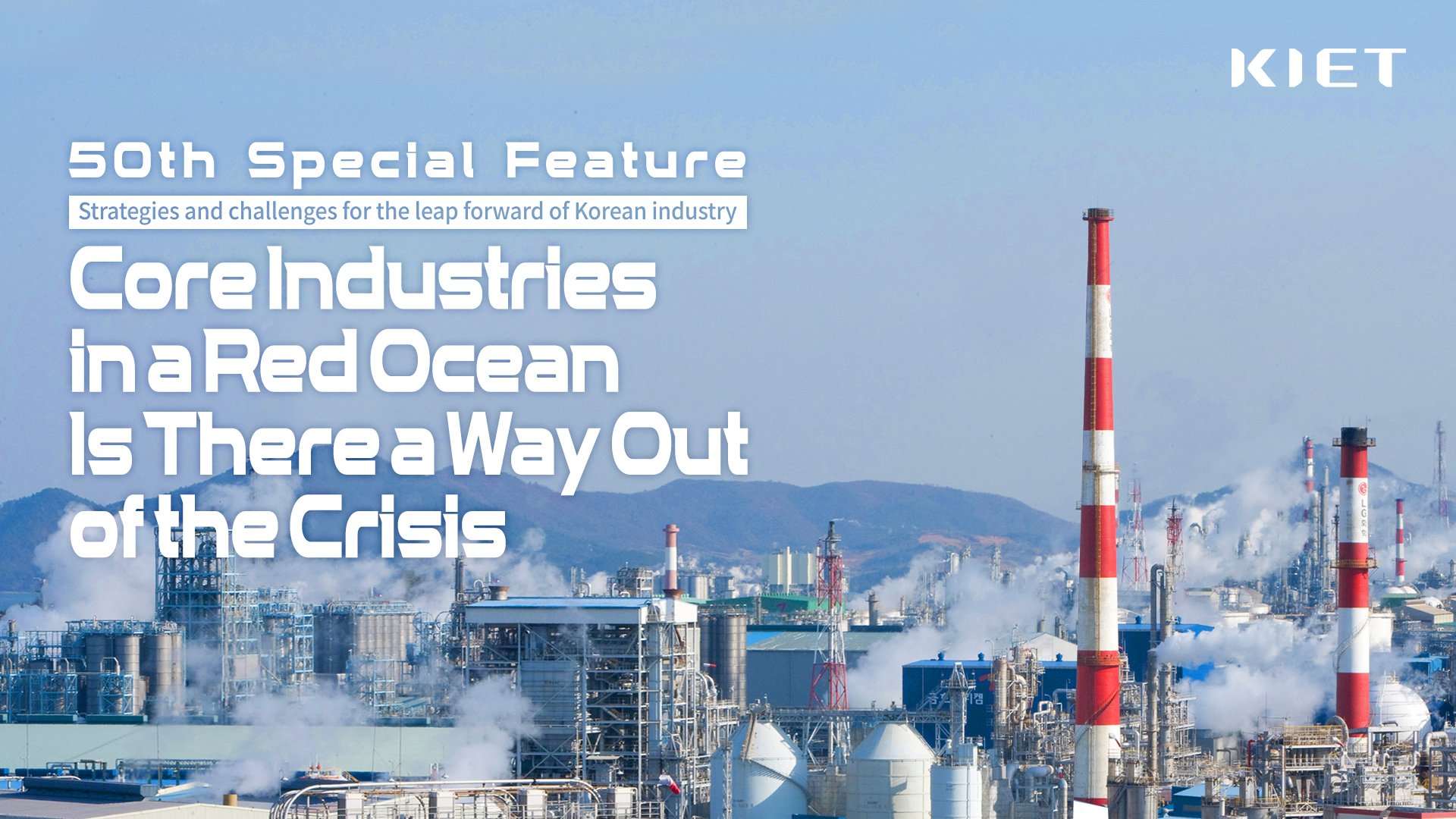
Core Industries in a Red Ocean: Is There a Way Out of the Crisis?
Three sturdy pillars have long upheld the Korean economy
petrochemicals, steel, and shipbuilding. These pillars are shaking.
From China’s indiscriminate flood of exports, to the formidable barrier of carbon neutrality,
to the rapidly shifting geopolitical landscape...
The time has come to fundamentally reassess the very framework of Korean industry.
The Structural Crisis of Korean Industry
Many view the current difficulties as a temporary economic downturn.
But the numbers tell a different story.
Korea’s manufacturing value-added ratio stands at 27.6%, stubbornly below the 30% figure in other major OECD economies.
We may have succeeded in producing things in large quantities, but we have much work to do in capturing commensurate value.
China rules the commodities market, and Korea is now feeling the squeeze.
The State of Korea’s Three Core Industries – Petrochemicals
In the past, the boom-and-bust cycle that dominates the petrochemicals sector was predictable.
But something has broken the cycle, and the industry has been trudging through a downturn for far too long.
The petrochemical sector’s key profitability indicator is known as the ethylene naphtha spread.
This number reached a nadir in the second half of 2022, almost four years ago, but has yet to recover.
The reason for this can be summed up in one word: China.
By 2022, China was already the world’s largest ethylene producer,
and is now on the verge of becoming entirely self sufficient in every stage of the ethylene value chain.
What was once Korea’s biggest customer has transformed into its most formidable competitor,
flooding markets with low-cost output.
Chinese ascendancy has had direct and deleterious effects on local Korean communities.
Local tax revenues from the Yeosu Industrial Complex (located near the southern coast of the country) are just half of what they once were.
This has set off a vicious cycle, with devastating effects on nearby commercial districts.
The State of Korea’s Three Core Industries – Steel
The year 2025 will go down as an especially painful one for Korean steel.
Domestic demand fell to its lowest level since 2002,
while surging electricity costs added further pressure, some steel plants run
by POSCO, Hyundai Steel, and Dongkuk Steel were forced to shut down or halt operations.
Cheap Chinese steel dumped onto the Korean market is a root cause of the problem, but weak domestic demand is another culprit.
Since the 2000s, China has rapidly scaled up steel production to the point where it now accounts for over half of global output.
The resulting oversupply has forced international prices into a tailspin, and Korean steelmakers have absorbed enormous losses in the process.
Adding to this, the second Trump administration has imposed steep tariff barriers on Korean steel exports.
The impact of the 50% steel tariff on U.S. imports will soon become fully apparent.
The EU too has signaled that it will cut import quotas significantly;
and there is also the Carbon Border Adjustment Mechanism to contend with.
The State of Korea’s Three Core Industries – Shipbuilding
The shipbuilding industry found itself in a prolonged slump following the 2008 global financial crisis.
Orders dried up and losses on foreign exchange derivatives forced many small and mid-sized shipyards to close.
From 2016 onward, losses on offshore plant projects and a continued order drought compelled even the major builders to undergo large-scale restructuring.
A crisis was readily apparent. But an opportunity for a rebound has emerged.
First, Korean shipbuilders maintained their competitive edge in high-value-added segments such as LNG carriers and eco-friendly vessels.
The global energy transition and shifting trade patterns have driven a surge in LNG demand,
while the maritime industry’s push for carbon neutrality has seen demand grow for green shipping options.
Second, favorable winds are blowing from the United States.
Korea’s proposed Korea–U.S. Shipbuilding Cooperation initiative, known as MASGA (Make American Shipbuilding Great Again),
played a significant role in reciprocal tariff negotiations with the U.S.
With its own shipbuilding capacity in decline, the U.S. urgently needs the expertise of Korea,
which possesses the world’s most advanced shipbuilding technology.
Through this bilateral cooperation, Korea’s shipbuilding industry expects to gain access to the U.S. as a major new market.
Three core industries that together constitute the beating heart of Korea’s export-driven economy are
showing signs of malaise, and the illness could spread throughout the national economy.
Korea once took pride in its global leadership, but many of its flagship industries have now been overtaken by China, or are on the verge of it.
What can Korea do?
If Korea’s core industries are to survive, they cannot rely on the strategies that led to prior successes.
They must either secure commanding technological leads or undertake bold business restructuring to pivot toward high-margin specialty products.
Leaving market forces to determine winners is no longer a viable option.
Around the world, governments are engaged in active policy competition to protect and advance their domestic industries.
Comprehensive support for upgrading the steel industry, including through the K-Steel Act, is urgently needed.
Japan has designated its shipbuilding industry as a national security asset,
The government is providing 1 trillion yen in support, describing the shipbuilding industry as one
that constructs vessels and warships to transport supplies and defend the nation in times of emergency.
Korea, too, needs to see shipbuilding and other core industries as more than just a line item on a spreadsheet.
These are major employers and exporters that are critical to national security.
To revitalize Korean manufacturing and strengthen industrial competitiveness,
we need to develop new growth paradigms and build collaborative systems aimed at upgrading the entire industrial ecosystem.
The government must play an active role in mitigating the risks of technological transition
and accelerating industrial transformation by calibrating R&D, infrastructure, and regulatory frameworks.
Korean industry – Don‘t just prepare for the future — make it. A crisis is an opportunity.
-
The First Crisis
Stalled Out: Weakening Industrial Competitiveness
The most obvious symptom of the Korean economy’s deteriorating health is the annual economic growth rate,
which now hovers in the 2% range, making the 5% rates posted just after the turn of the millenium seem mythical by comparison.
The Korean economy has, in other words, gotten real old, real fast.
And not just old, but ossified. How do we know this? Twenty years ago,
Korea’s main exports were semiconductors, cars, and chemicals.
Today, Korea’s main exports are...semiconductors, cars, and chemicals.
The economy lacks dynamism; there‘s no new blood circulating through its veins.
Over the past decade, the percentage of new market entrants has fallen to 6% from 9%;
market exits by incumbent firms also fell from 7% to 5% over the same period.
The patient not only has a weak heart, but a poor metabolism as well.
The Second Crisis
Cracks in the Facade: Declining Innovation Capacity
The patient looks weak. And the internals are in even worse shape.
The economy is plagued by numerous marginal enterprises,
or zombie firms, whose profits aren’t enough to pay the interest on their debts,
let alone the principal. Since the COVID pandemic, the number of marginal enterprises has skyrocketed.
The risk of widespread corporate insolvency is real and growing.
Having so much capital tied up in zombie firms hinders innovation.
Korea is considered an AI powerhouse,
but AI adoption rates in the country’s enormously important manufacturing sector sit at just 3.9%.
The Third Crisis
Storms Abroad: Upheaval in the Global Environment
To make matters worse, the playing upon which Korea achieved so much success — the global free trade regime — has been ripped out.
The Inflation Reduction Act (IRA) and the CHIPS and Science Act were the tools through
which the US did the deed. Both laws provide massive subsidies to firms that invest in the US.
This is why Samsung builds new factories in Texas and Hyundai puts up new production lines in Georgia instead of Korea.
And it would be a mistake to think of the current global trade environment has one of mere ’disputes.’ In 2023,
71% of all trade-distorting policies were promulgated by advanced countries that directly compete with Korea.
What we’re seeing is a fundamental transformation of the global industrial environment.
Korea was one of the first fast-followers and one of that model’s greatest success stories.
But it no longer represents a viable survival strategy.
Another issue: The green transition is coming and Korea is not ready for it.
The European Union (EU) Carbon Border Adjustment Mechanism (CBAM) is imminent,
but Korea’s energy mix remains dominated by fossil fuels, with renewables account for just 9.5% of power generation.
This lags far below global leaders like Germany (57.3%) and even China (32.6%).
Four Strategies for Tackling Korea’s Industrial Crisis
Strategy 1: AI and the Green Economy
We propose four strategies for tackling Korea’s multifaceted industrial crisis.
The first: embrace the AI-powered future.
It will not be enough to merely adopt new technology: Korean firms need to address real world-problems using AI solutions.
For example: wearable robotics embedded with AI tech for use in the construction sector and other industries
that are now suffering from a major shortage of skilled workers.
The same goes for green technologies. For POSCO, Hyundai, or any other major steelmaker to spend billions to convert
their pollution-intensive blast furnaces to more eco-friendly solutions (hydrogen-reduction, for example),
the government would have to implement Carbon Contracts for Difference (CCfDs)
or some other mechanism in order to offset risk and get companies moving down the path of decarbonization.
Strategy 2: Policy Reform
Among other things, Korea’s industrial innovation system is in need of a major overhaul,
and this has to start with a change in the industrial R&D ecosystem.
Rather than being misled by the ostensible 90% success rate,
industrial R&D should be assessed on the basis of their real market outcomes.
Industrial innovation is what happens when technologies achieve success in the market.
Korea also needs to completely reconsider its approach to attracting investment.
Successfully attracting investment requires a mix of tax incentives, financial subsidies, and human resources support.
Currently, these functions fall under the purview of different ministries.
This dispersed and opaque system makes attracting large-scale investment from global firms extremely difficult.
The country also needs to shift refocus its investment attraction efforts from firms to projects.
Korea should make every effort to participate in projects led by global leaders;
this will help build out entire industrial ecosystems in Korea, rather than just individual firms.
Another thing to consider: Korean firms make a lot of money overseas,
but currently have little incentive to repatriate this money and reinvest profits in Korea.
The government needs to see capital repatriation as a kind of capital “reshoring,”
and offer benefits commensurate with those extended to foreign firms investing in Korea.
As for the country’s zombie firms, the solution is not to simply let them close their doors forever.
The government needs to let firms capable of growing realize their potential by allowing them to divest unprofitable
or low-value-added lines of business and shift to newer or more promising ones.
Policies that enable this can create new engines of economic growth,
but will require proactive and attentive policy support.
As for the regulatory regime, well — reform requires a top-down approach.
We need to analyze and reform laws and policies that act as constraints on entire industrial sectors.
Regulatory reform should be done on a case-by-case basis.
We should seek to make improvements to individual statutes to maximize regulatory consistency
and predictability and drive tangible change at the country’s businesses.
Strategy 3: Recalibrating Korea’s Foreign Policy
Next up: Korea also needs to rethink its global strategy.
For one, it needs to expand and strengthen cooperation with the US in critical strategic industries like biotech and semiconductors.
And when it comes to China, Korea should pursue a bifurcated strategy.
In areas where we still have the advantage, it is crucial that we maintain a super-gap with the Chinese competition.
In other areas, it is best to take a more pragmatic approach, and determine
where Korean firms can leverage the Chinese market and advanced manufacturing supply chains,
seeking out collaborative opportunities in segments where they are competitive.
For example, Korean suppliers could look to sell advanced electrical components to the Chinese EV sector.
Strategy 4: Upgrading Key Industries and Fostering Future Growth
Finally, Korea must address two other major challenges simultaneously.
The country must help its incumbent industries climb up the value-added ladder
while at the same time fostering an ecosystem that can create the next Samsung or Hyundai.
This is a daunting task. It’s like building a new ship while navigating a storm on the old leaky boat.
But we live in extraordinary times, and seeing Korean industry through the storm will require marshaling every resource available.
-
(Intro)
Hello. My name is Kyung-in HWANG, Director of the Office of Public Relations and Media at the Korea Institute for Industrial Economics and Trade (KIET).
As KIET marks its 50th anniversary, we are hosting a series of dialogues with leading international scholars
in which they share their insights on rapidly changing industrial conditions and major policy issues.
Today, we will be speaking with Dr. Guy Lalanne, Acting Head of Division — Productivity, Innovation,
and Entrepreneurship at OECD Directorate for Science, Technology and Innovation.
Lalanne previously served as Deputy Director of the Macroeconomic Forecasting Division
and the Business Policy, R&D and Innovation Division at the French Ministry of Finance.
Q1.
We understand the OECD recently built a database called QuiS,dedicated specifically to industrial policy.
Could you explain the background behind this initiative?
Q2.
Many countries are pursuing industrial policy on a significant scale, leading some to declare that we have entered a new era of muscular industrial policy.
However, in your contribution to IER, you note how the number of announced policies far exceeds the number of policies that have been actually implemented.
Are we really in a new era of tough industrial policy?
Q3.
In terms of policy instruments, direct fiscal support has been increasing, while the use of financial instruments (such as the creation of funds) appears to be declining.
What do you think is driving countries to choose this particular mix?
Q4.
Another notable feature is that once industrial policies are introduced,
they tend to persist over long periods without sunset clauses or termination, regardless of their effectiveness.
What do you see as the underlying cause of this tendency?
Q5. Looking at the areas receiving support, there has been a sharp increase in spending on the green transition, SMEs, and rising energy costs.
In your view, which of these areas is most likely to contribute to long-term productivity growth?
(Outro)
So far, I have been talking with Professor Guy Lalanne.
The 50th Anniversary Special Project: Dialogues with International Scholars will continue in the future,
so please show your interest and watch.
Thank you.
-
(Intro)
Hello. My name is Kyung-in HWANG, Director of the Office of Public Relations and Media at the Korea Institute for Industrial Economics and Trade (KIET).
As KIET marks its 50th anniversary, we are hosting a series of dialogues with leading international scholars
in which they share their insights on rapidly changing industrial conditions and major policy issues.
Today we will be speaking with Shujiro URATA, Professor Emeritus at Waseda University.
Professor Urata is also chairman emeritus at the Research Institute of Economy, Trade, and Industry (RIETI) in Tokyo,
a Specially Appointed Fellow at the Japanese Center for Economic Research (JCER),
a Distinguished Senior Fellow at the Institute of Developing Economies (IDE-JETRO),
and chairman of the East Asian Economic Association (EAEA).
Q1.
Professor, you spoke about the global resurgence of industrial policy, including in Japan.
My first question is whether you could briefly walk us through how Japan's industrial policy has evolved since the end of World War II.
Q2.
As a leading authority on the Japanese economy, how would you assess Japan's industrial policy over the years?
Q3.
You have argued that the race among major countries to roll out competitive industrial subsidies could have unintended consequences.
What implications do you see this carrying for Japan?
Q4.
The semiconductor industry is arguably the single most important industry for both Korea and Japan.
And so I can’t can’t help but ask you the policies the Japanese government has pursued to foster its semiconductor industry.
Could you give us a brief overview?
What should Korea do to strengthen its own semiconductor industry?
Q5.
Lastly, I’d like to ask about the relationship between Japan and Korea.
These two countries find themselves caught between the United States and China,
occupying a dual role as both competitors and allies.
What does the future hold for this dyad?
(Outro)
So far, I have been talking with Professor Shujiro URATA.
The 50th Anniversary Special Project: Dialogues with International Scholars will continue in the future,
so please show your interest and watch.
Thank you.
-
(Intro)
Hello. My name is Kyung-in HWANG,
Director of the Office of Public Relations and Media at the Korea Institute for Industrial Economics and Trade (KIET).
As KIET marks its 50th anniversary,
we are hosting a series of dialogues with leading international scholars in
which they share their insights on rapidly changing industrial conditions and major policy issues.
Today we're talking with ITIF President Rob Atkinson.
Rob Atkinson is the founder and president of ITIF,
one of the world’s leading science and technology policy think tanks
He also serves as a nonresident senior fellow at the Brookings Institution,
and as a member of the Science, Technology, and Innovation Council under the Canadian Academy of Sciences.
In the past, he was the first executive director of the Rhode Island Economic Policy Council.
Q1.
In your Industrial Economic Review article, you characterize China as a country pursuing a state-led, winner-takes-all strategy,
and you argue that this strategy could pose an existential threat to the South Korean economy.
Could you explain in greater detail how we got here and led our current moment?
Q2.
You point explicitly to weak productivity in the service sector as one of the culprits behind Korea’s stagnant growth, especially compared to years past.
You also argue that Korea needs to formulate a new, state-led productivity innovation strategy,
noting that could Korea could reference a similar strategy ITIF proposed in the American context.
Could you briefly go over its key features and point to some of the implications for Korea?
Q3.
In your article you briefly touch on how Korea’s zeal for private, after-school cram schools may actually hinder social and economic innovation.
How do you think reforming the current system, which is characterized by a preference for a handful of prestigious, “name-brand” universities,
to create a more flexible and autonomous learning environment could contribute to promoting innovation in Korea?
Q4.
Korean society has long been somewhat averse to taking risks and starting a business.
Youth entrepreneurship in particular is declining,
and one public opinion survey has identified fear of failure as the biggest obstacle to entrepreneurship.
What policy tools should be considered to help address this issue?
(Outro)
So far, we've been talking with Chairman Rob.
The 50th Anniversary Special Project: Dialogues with International Scholars will continue in the future,
so please show your interest and watch.
Thank you.
-
(Intro)
Hello. My name is Kyung-in HWANG,
Director of the Office of Public Relations and Media at the Korea Institute for Industrial Economics and Trade (KIET).
As KIET marks its 50th anniversary,
we are hosting a series of dialogues with leading international scholars in
which they share their insights on rapidly changing industrial conditions and major policy issues.
In this inaugural episode, we will be speaking with Professor Gary Gereffi,
one of the world’s foremost experts on global value chains.
Professor GEREFFI currently serves as Director of the Global Value Chains Center at Duke University,
and has previously served as an adviser to the World Economic Forum.
One of pioneers of the global value chain (GVC) analytical framework,
he has provided advisory support to a range of international organizations,
including the United Nations, the World Bank, and the International Labour Organization (ILO).
He is widely recognized as one of the foremost authorities in his field.
Q1.
Professor, in your work, you have argued that a year-long global economic crisis has eroded the long-standing free trade regime
and has given rise to a new economic order that is fragmented and multipolar.
Could you briefly explain what this new economic order entails, and how it differs from the system that preceded it?
Q2.
Professor, in your article published in Industrial Economic Review (IER) (available at KIET’s homepage),
you emphasized that advancing green industries and building sustainable value chains can provide not only advanced economies
but also emerging economies with opportunities to enhance their economic standing.
At the same time, the Trump administration in the United States has signaled an unfriendly stance toward the broader green policy agenda.
How should countries that are seeking to foster green industries interpret and respond to this direction in US policy?
Q3.
In your earlier research, you have often analyzed cases in which trade policy produced unintended outcomes
that diverged from policymakers’ original intentions.
Recently, major countries have been pursuing trade policy more assertively.
Do you think there is a possibility that these countries’ trade policies could backfire and generate adverse effects?
For a country like Korea, which is highly dependent on trade,
what risks or pitfalls do you think policymakers should be especially careful to guard against when designing and implementing trade policy?
Q4.
Professor, in your IER article you also referenced the concept of “weaponized interdependence.”
Many countries are now working actively to build more resilient domestic supply chains.
In your view, how will these supply-chain policies affect the ability of states to sustain or intensify strategies of weaponization?
Q5.
As strategic competition between the United States and China has recently intensified,
as a relatively open economy dependent on trade with both Korea finds itself in an increasingly difficult position between the two.
Under these circumstances, what realistic options does Korea have when it comes to industrial strategy?
(Outro)
The 50th Anniversary Special Project: Dialogues with International Scholars will continue in the future,
so please show your interest and watch.
Thank you.
-
Rapid technological innovation, led by the AI revolution, is reshaping the industrial landscape.
But technology is not the only variable at play. Shifting US trade policy, China’s increasing self-sufficiency — as well as its slowing economy — are all forcing South Korean industries to recalibrate.
In Korea, 13 flagship industries have long underpinned the economy.
Heading into 2026, which of these sectors will grow, and which will need to adjust?
(Part 1. Export Outlook: Technology Fuels Growth; Structural Constraints Trigger Realignment)
First, looking at the export trends for Korea’s 13 flagship industries in 2026,
IT and biotech are expected to lead growth.
However, continued weakness in the materials sector is likely to weigh on overall exports,
with the value of outbound shipments projected to decline by about 0.6% year-on-year.
In the machinery industries, exports are forecast to fall by roughly 2%,
reflecting US tariff pressures and the localization of production overseas.
Shipbuilding exports are expected to dip slightly due to fewer shipments of high-value offshore platforms, but exports should remain at a relatively high level overall.
In the materials sectors, textiles exports should reassume an upward trajectory,
but exports of refined oil, steel, and petrochemicals are likely to remain soft. Overall, exports are set to tumble by 7.6% in the materials industries.
The outlook for emerging IT-driven industries is more positive.
As AI-related demand continues to grow and demand for high-value components expands, exports of ICT devices, home appliances, and displays are expected to climb; sectoral exports are projected to increase by about 4.2% overall.
Semiconductor exports should continue to benefit from robust demand for high-value products, including High Bandwidth Memory (HBM) and DDR5 memory.
However, the base effect is expected to moderate overall growth prospects.
Biohealth exports are projected to jump by 7.8%, buoyed by greater exports by contract development and manufacturing organizations (CDMO) and steady growth in key product categories.
Exports of secondary batteries, on the other hand, are expected to decline by around 12%,
as overseas production expands and demand for electric vehicles falls.
(Part 2. Domestic Demand Outlook: “A mild recovery, but at different speeds across industries”)
Domestic demand in most industries is expected to increase,
on the back of a recovery in private consumption and investment.
In the machinery industries, domestic demand for automobiles looks set to dip slightly, as models age and the economy slows.
The shipbuilding industry is expected to undergo a sharp adjustment as orders for LNG carriers and container ships are scaled back.
Demand for general machinery, however, is projected to rise as facility and construction investment gradually recovers.
In the materials industries, the steel, refining, petrochemicals, and textiles sectors are all expected to see more demand, though stiff structural headwinds remain.
The demand outlook for the emerging IT industries is more sanguine.
Investment in AI and related industries is poised to continue growing as demand surges; demand for semiconductors alone is expected to soar by more than 70%.
Demand in the displays and home appliances sectors should also return to a growth pattern.
Domestic demand for both secondary batteries and biohealth products is expected to expand at a double-digit pace as well.
(Part 3. Production Outlook: An Inflection Point for Korean Industries)
Estimates of production for 2026 paint a picture of industrial divergence.
Sectors in the emerging IT industries are expected to show clear gains,
reflecting strong export momentum and robust domestic demand.
But battery production is projected to tumble by 9.8%
as battery makers move production abroad.
In the machinery industries, automobile production is expected to edge up slightly
as new EV plants come online, while production of general machinery should remain broadly flat,
with domestic demand providing support.
Domestic shipbuilding production, by contrast, is projected to fall by 9.7%
due to the base effect and reduced container ship construction.
In the materials industries, only the textiles sector is expected to see a bump in production, albeit marginal.
Production in the steel, petrochemicals, and oil refining sectors is poised to fall again,
amid weak demand, slowing exports, and
challenging global supply conditions.
(Part 4. Import Outlook: Recovery and Reallocation)
Imports in 2026 are projected to increase by 2.9% year-on-year.
Imports of general machinery and shipbuilding-related items are expected to continue rising, while automobile imports may dip slightly as Korean consumers seem to increasingly prefer domestic makes and models.
In the materials sectors, imports are expected to increase, concentrated in the textiles and petrochemicals sectors.
Imports of refined oil should fall, however, plunging by 15.9% as prices decline.
In the emerging IT industries, imports are also expected to increase, in line with expanding production.
Only the battery sector is likely to see a continued decline in imports,
reflecting the repeated pattern of expanding overseas production.
Imports continue to show upward momentum in the emerging IT sectors, in line with increased production. Demand for domestic system semiconductors is set to increase by 6.9%, while imports of ICT devices look set to climb by 4.3% on the back of rising demand for AI-equipped smartphones and PCs.
In the biotech sectors, it looks like imports will jump by as much as 11.4%, owing to higher unit prices and higher volumes, which are both increasing in tandem. Battery imports are likely to soar even higher, with imbound shipments surging by 17.6% YoY as the domestic market for EVs continues to expand.
(Outro)
In 2026, AI, biohealth, and next-generation semiconductors are poised to reshape the industrial paradigm for Korea’s 13 flagship industries,
while traditional industries such as oil refining, steel, and petrochemicals restructure and readjust in pursuit of a new equilibrium.
Amid so much uncertainty, one thing is clear: Technology is shaping the future of the Korean economy.
-
Rapid technological innovation, led by the AI revolution, is reshaping the industrial landscape.
But technology is not the only variable at play. Shifting US trade policy, China’s increasing self-sufficiency — as well as its slowing economy — are all forcing South Korean industries to recalibrate.
In Korea, 13 flagship industries have long underpinned the economy.
Heading into 2026, which of these sectors will grow, and which will need to adjust?
(Part 1. Export Outlook: Technology Fuels Growth; Structural Constraints Trigger Realignment)
First, looking at the export trends for Korea’s 13 flagship industries in 2026,
IT and biotech are expected to lead growth.
However, continued weakness in the materials sector is likely to weigh on overall exports,
with the value of outbound shipments projected to decline by about 0.6% year-on-year.
In the machinery industries, exports are forecast to fall by roughly 2%,
reflecting US tariff pressures and the localization of production overseas.
Shipbuilding exports are expected to dip slightly due to fewer shipments of high-value offshore platforms, but exports should remain at a relatively high level overall.
In the materials sectors, textiles exports should reassume an upward trajectory,
but exports of refined oil, steel, and petrochemicals are likely to remain soft. Overall, exports are set to tumble by 7.6% in the materials industries.
The outlook for emerging IT-driven industries is more positive.
As AI-related demand continues to grow and demand for high-value components expands, exports of ICT devices, home appliances, and displays are expected to climb; sectoral exports are projected to increase by about 4.2% overall.
Semiconductor exports should continue to benefit from robust demand for high-value products, including High Bandwidth Memory (HBM) and DDR5 memory.
However, the base effect is expected to moderate overall growth prospects.
Biohealth exports are projected to jump by 7.8%, buoyed by greater exports by contract development and manufacturing organizations (CDMO) and steady growth in key product categories.
Exports of secondary batteries, on the other hand, are expected to decline by around 12%,
as overseas production expands and demand for electric vehicles falls.
(Part 2. Domestic Demand Outlook: “A mild recovery, but at different speeds across industries”)
Domestic demand in most industries is expected to increase,
on the back of a recovery in private consumption and investment.
In the machinery industries, domestic demand for automobiles looks set to dip slightly, as models age and the economy slows.
The shipbuilding industry is expected to undergo a sharp adjustment as orders for LNG carriers and container ships are scaled back.
Demand for general machinery, however, is projected to rise as facility and construction investment gradually recovers.
In the materials industries, the steel, refining, petrochemicals, and textiles sectors are all expected to see more demand, though stiff structural headwinds remain.
The demand outlook for the emerging IT industries is more sanguine.
Investment in AI and related industries is poised to continue growing as demand surges; demand for semiconductors alone is expected to soar by more than 70%.
Demand in the displays and home appliances sectors should also return to a growth pattern.
Domestic demand for both secondary batteries and biohealth products is expected to expand at a double-digit pace as well.
(Part 3. Production Outlook: An Inflection Point for Korean Industries)
Estimates of production for 2026 paint a picture of industrial divergence.
Sectors in the emerging IT industries are expected to show clear gains,
reflecting strong export momentum and robust domestic demand.
But battery production is projected to tumble by 9.8%
as battery makers move production abroad.
In the machinery industries, automobile production is expected to edge up slightly
as new EV plants come online, while production of general machinery should remain broadly flat,
with domestic demand providing support.
Domestic shipbuilding production, by contrast, is projected to fall by 9.7%
due to the base effect and reduced container ship construction.
In the materials industries, only the textiles sector is expected to see a bump in production, albeit marginal.
Production in the steel, petrochemicals, and oil refining sectors is poised to fall again,
amid weak demand, slowing exports, and
challenging global supply conditions.
(Part 4. Import Outlook: Recovery and Reallocation)
Imports in 2026 are projected to increase by 2.9% year-on-year.
Imports of general machinery and shipbuilding-related items are expected to continue rising, while automobile imports may dip slightly as Korean consumers seem to increasingly prefer domestic makes and models.
In the materials sectors, imports are expected to increase, concentrated in the textiles and petrochemicals sectors.
Imports of refined oil should fall, however, plunging by 15.9% as prices decline.
In the emerging IT industries, imports are also expected to increase, in line with expanding production.
Only the battery sector is likely to see a continued decline in imports,
reflecting the repeated pattern of expanding overseas production.
(Outro)
In 2026, AI, biohealth, and next-generation semiconductors are poised to reshape the industrial paradigm for Korea’s 13 flagship industries,
while traditional industries such as oil refining, steel, and petrochemicals restructure and readjust in pursuit of a new equilibrium.
Amid so much uncertainty, one thing is clear: Technology is shaping the future of the Korean economy.
-
![영상보고서_[KIET forecast] The outlook for South Korea‘s flagship industries in H2 2025](/upload/vdo/84/F366EB4FBD_1750141928459_84.jpg) [KIET forecast] The outlook for South Korea‘s flagship industries in H2 2025
[KIET forecast] The outlook for South Korea‘s flagship industries in H2 2025Lee, Jae Yoon2025.06.13
Hello. I’m Jae Yoon Lee,
Research Fellow and Director of the Office of Carbon Neutrality and Industrial Transition Research at the Korea Institute for Industrial Economics and Trade.
I’ll be discussing the outlook for South Korea’s 13 flagship industries in 2025.
For 2025, production is set to slow down in many of Korea‘s 13 flagship industries, saving only for a handful of IT-driven sectors,
due to escalating trade risks, a sluggish global economic recovery, and increased outsourcing overseas.
We expect export growth to fall and weak growth in domestic demand.
Overall, robust global demand for IT products should to support healthy production and exports of ICT devices, semiconductors, and displays.
The biotech and shipbuilding are likely to slow down in the second half of the year,
but are nonetheless slated to post positive growth year-over-year (YoY).
The automotive, machinery, steel, oil refining, home appliances, and secondary batteries sectors are expected to remain in recession during the first half of the year due to sluggish domestic and global demand.
We do however anticipate a modest improvement in the petrochemicals industry in the second half of the year, and a full-scale recovery could be in the cards post-2026.
Now, let's take a closer look at the outlook for each of Korea’s 13 flagship industries in the second half of 2025 through detailed graphs.
First, let’s examine each industry’s export outlook for the second half of 2025.
Despite continued export growth in emerging industries such as IT and biotech,
exports of the 13 flagship industries in the second half of 2025 are expected to decline by 2.3% year-on-year
due to prevailing negative factors, such as high US tariffs, intensifying external uncertainties, and increased outsourcing of production abroad.
Due to the reverse base effect and other contributing factors, by the time the first half of 2025 comes to a close,
overall exports are likely to have tumbled by 1.9%, resulting in an annual export decline of 2.1% compared to the previous year.
Among the machinery industries, the shipbuilding sector should expected maintain its growth trajectory in exports (3.4%) in the second half thanks to deliveries of high-value LNG carriers.
However, exports of automobiles (-11.4%) and machinery (-5.8%) are expected to decline further in the second half of the year due to US tariffs and sluggish global demand.
As a result, annual exports in the machinery sector — which grew by 0.6% last year — are expected to fall by 5% in 2025.
In the materials sector, lower oil prices, higher US tariffs,
and weakening global demand are expected to result in weak exports across all subsectors throughout the year.
Overall, sectoral exports look set to plummet by -9.4% in 2025, after falling by -1.2% in the previous year.
After a 29.4% surge in 2024, exports for the IT industry and emerging new sectors are expected to continue growing by 4.7% in 2025,
supported by strong global IT demand driven by AI adoption, an increasing share of high-value semiconductors,
and the growth of promising sectors such as biosimilars and energy storage systems (ESS).
However, risks such as tariffs, rapid Chinese growth, and expanded outsourcing are expected to act as constraints on export growth.
Next is the domestic demand outlook for Korea’s 13 flagship industries for the second half of 2025.
The overall decline trend in domestic demand for the 13 flagship industries should soften somewhat in the second half of 2025, aided by improved consumer sentiment.
However, sluggish construction investment and weak domestic and global growth will continue to constrain demand growth.
In the machinery sector, domestic demand for automobiles (2.1%) is expected to increase in the second half of the year as domestic automakers turn their focus to the domestic market.
But domestic demand for general machinery (-1.7%) is expected to decline in the second half of the year due to the slump in the construction and manufacturing sectors.
In the materials sectors, domestic demand for petrochemicals is expected to rebound by 6.3% in the second half.
However, overall annual demand growth is likely to be negative (-0.2%).
And due to weak construction investment, steel demand is also expected to fall (-4.7%). Domestic demand for textiles should remain flat (0.7%).
In the IT industry and emerging new sectors, new product launches and improved electric vehicle (EV) sales are expected to drive a rebound
in domestic demand for ICT devices (5.5%) and secondary batteries (6.8%) in the second half of 2025.
However, domestic demand growth in the biohealth sector is projected to decline by nearly three percentage points in the second half of 2025 due to the base effect,
but overall expanded policy support will allow the sector to see continued annual demand growth of 2.2%.
Next is the production outlook for the Korea’s 13 flagship industries in the second half of 2025.
Production in most sectors should continue to tumble in the second half of 2025,
following downturns observed in the first half of the year as exports stumble and domestic demand recovers only modestly.
In the machinery sectors, annual production is expected to decline for the second consecutive year,
as the decline trend in production of automobiles (-4.4%) and general machinery (-3.5%) worsens in the second half amid sluggish exports and domestic demand.
Although production in the shipbuilding sector is projected to drop by 5.8% in the second half of the year,
the industry should post positive overall annual growth (5.0%) as production is normalized.
In the materials sector, continued export sluggishness and a restrained domestic recovery are expected to result in further production declines
in the steel (-1.3%), refining (-2.2%), and textiles (-1.4%) subsectors during the second half of the year.
However, the petrochemicals (-0.4%) industry could see an uptick in production (3.5%) due to improved product spreads and higher capacity utilization.
Although production growth in the emerging IT industries is expected to slow in the second half of 2025 compared to the first,
increased exports should bolster production in the ICT devices (2.1%), semiconductors (2.3%), and biotech (3.1%) subsectors.
On the other hand, production in the home appliances (-0.5%) and secondary batteries (-2.2%) sectors is expected to fall again in the second half of the year as firms outsource production abroad.
Finally, let’s take a look at outlook for imports in Korea’s 13 flagship industries for the second half of 2025.
Despite rising imports of IT products, total imports in the 13 flagship industries are expected to decline by 0.5% YoY
due to slack domestic demand in the machinery and materials sectors and falling unit prices caused by an increase in low-cost imports.
In the machinery sectors, overall imports of automobiles are expected to tick downward due to increased imports of low-cost EVs,
while imports of general machinery should remain flat amid weak recovery in the manufacturing sectors.
However, shipbuilding imports are projected to increase due to localization of equipment.
In the materials sectors, imports of steel are expected to plunge as domestic demand falters and new restrictions on imports take effect.
Imports of refined oil are also likely to dip as unit prices fall.
However, with improving domestic demand and an increasing influx of low-cost imports, imports of petrochemicals and textiles are expected to grow slightly.
In the emerging IT industries, imports of IT products and home appliances are expected to increase in the second half of the year,
driven by improved consumer sentiment. Imports of semiconductors used in the development of advanced technologies are also projected to continue,
while the decline in secondary battery imports is expected to slow significantly due higher domestic demand for imported batteries. -
Hello.
I’m Sung Wook HONG, Senior Research Fellow and Director of the Office of Economic Outlook at the Korea Institute for Industrial Economics and Trade.
I’d like to discuss the current economic conditions in South Korea and the world and the macroeconomic outlook for 2025.
Recently, Korea’s real economy has entered a downturn, driven by a decline in exports due to weak unit prices of major export items early in the year,
sluggish demand amid intensifying global uncertainties, and a reverse base effect from strong performance during the same period last year.
In addition, heightened domestic political uncertainty has dampened consumption and investment, resulting in sluggish performance across all sectors.
As the global economy enters a transitional phase driven by changes in US trade policy,
global economic growth in 2025 is expected to fall off from its 2024 performance.
Assuming an average annual oil price of around USD 67 per barrel and a 3.6% increase in the KRW/USD exchange rate compared to the previous year,
Korea’s economy is projected to grow by around 1% in 2025.
Domestic demand should tick up modestly, with private consumption increasing by 1.0%
and facility investment by 1.8%. Construction investment, on the other hand, is set to contract by 4.7%.
Exports and imports are forecast to decline by 1.9% and 2.1%, respectively.
Now, let’s take a look at a few graphs for more details.
First is the outlook for economic growth in 2025.
In 2025, Korea’s economy is expected to grow at around 1% year-over-year (YoY).
This weak figure owes to sluggish exports and lower trade volumes triggered by uncertainties surrounding US tariff policy.
Despite the launch of a new government and supplementary budget effects, recovery in domestic demand is projected to remain quite mild.
Domestically and globally, key variables will include the ripple effects of the US-China trade conflict,
uncertainties surrounding trade and monetary policy, and the potential for increased financial market volatility.
On the domestic front, additional variables include consumer and investment sentiment,
and the extent of any decline in exports due to worsening trade conditions.
An easing of US-China trade tensions and a more favorable trade environment might prompt an upward adjustment to Korea’s economic prospects this year.
Also, the launch of the new administration and its economic stimulus policies could have a positive impact on the Korean economy.
Next up is the outlook for private consumption.
Overall, private consumption is expected to grow by around 1.0% compared to the previous year,
aided by the launch of a new government and easing political uncertainties,
likely interest rate cuts, and expectations for economic stimulus from the new administration.
But overall consumption growth will be capped due to persistently high levels of household debt,
rising perceived inflation, and only a modest recovery in consumer sentiment.
Next up is the outlook for investment.
Despite rising prices of imported capital goods and heightened uncertainty in major countries’ trade policies dampening investment sentiment,
overall facility investment should actually increase by about 1.8% YoY supported by continued strength in the semiconductor industry driven by robust demand for high-value memory chips.
Construction investment, however, is expected to tumble by 4.7% compared to the previous year,
as leading indicators for the construction market remain weak,
with growing unsold housing inventories and sluggish trends in permitting and groundbreaking.
Finally, let’s take a look at the outlook for exports and imports.
Exports in 2025 are expected to decline by 1.9% YoY.
Although exports of AI-related semiconductors, ICT devices, shipbuilding, and biotech products should remain strong,
the continued US-China trade conflict, uncertain U.S. tariff policy under the Trump administration,
and a global trade contraction are likely to weigh on overall exports.
Imports are also expected to decline by about 2.1% compared to the previous year despite a weaker won,
as oil prices fall and demand for intermediate goods contracts amid a sluggish export environment.
Overall, the balance of payments for 2025 is projected to sit at USD 52.4 billion, a slight increase over 2024.
[REPORT]
https://www.kiet.re.kr/trends/ecolookView?ecolook_no=52&skey=&sval=




![영상보고서_[KIET forecast] The outlook for South Korea‘s flagship industries in 2026](/upload/vdo/87/1FBC4D40CE_1767935729239_87.jpg)
![영상보고서_[KIET forecast] South Korea‘s economic outlook for 2026](/upload/vdo/86/504E754380_1767935046522_86.jpg)
![영상보고서_[KIET forecast] South Korea‘s economic outlook for H2 2025](/upload/vdo/83/FE6C643E5F_1750141906990_83.jpg)
Please enter the security text below
to prevent email collection
Please check the information of the person in charge.